
Benchmark equity indices Sensex and Nifty tumbled more than 1 per cent on Friday due to across-the-board selloff, especially in metal, IT and commodity stocks, tracking sluggish global markets.

Opposition MPs in the Rajya Sabha criticised the Modi government's economic policies, citing the LPG crisis, lack of energy security, and concerns over the Economic Stabilisation Fund.

Equity benchmark indices Sensex and Nifty experienced a significant decline, primarily driven by a selloff in IT stocks due to concerns about AI disruption and renewed worries over global trade.

Asset financing firms are still witnessing subdued demand and meaningful recovery is likely only in FY16, the report said.

After investing a staggering amount in May, foreign investors turned net sellers with a withdrawal of Rs 8,749 crore from the Indian equity markets in the first week of this month triggered by renewed US-China trade tensions and rising US bond yields. This momentum follows a net investment of Rs 19,860 crore in May and Rs 4,223 crore in April, data with the depositories showed.

'Trade deal will act as a strong trigger for market sentiment, not just for domestic investors but also for FIIs.'

Benchmark equity indices Sensex and Nifty extended their gains for the third straight session on Wednesday, driven by last-hour buying in bank, metal, and FMCG shares.

Just over a year ago, India was investors' top pick among EMs. Its slide down the rankings follows $30 billion (over 2.5 trillion) of foreign selling over the past 12-13 months.

The United States, which entered this war in expectation of a short, sharp win along the Venezuela model, is now preparing for deeper involvement in a conflict it does not fully control, without the allies it typically relies on, against an adversary that is not behaving as expected, in a global environment that is already absorbing economic shock. Prem Panicker continues his must read daily blog on the Gulf War.

The exodus of FPIs from the Indian equity markets continues unabated, as they withdrew Rs 64,156 crore ($7.44 billion) this month so far on depreciation of the rupee, rise in the US bond yields and expectation of a tepid earning season. This came after an investment of Rs 15,446 crore in the entire December, data with the depositories showed.

After a year of modest returns, equity investors may anticipate gains of 10-15 per cent in Samvat 2082, which began on October 21. Although valuations have moderated from their peaks a year earlier, they remain above long-term averages, potentially limiting sharp upsides.

The rupee appreciated 13 paise to close at 90.34 against the US dollar on Thursday, on trade deal optimism and overnight decline in commodity prices, even as the upside remained capped as investors look for more clarity on the India-US trade deal.

India is well-stocked with inventories of crude oil and key petroleum products, including petrol, diesel, and aviation turbine fuel (ATF), to deal with short-term disruptions as the war intensifies in West Asia, Union Minister of Petroleum and Natural Gas Hardeep Singh Puri said on Tuesday.

Among its 27 recommendations for the Union Budget is this: It has suggested that equity investments held for more than one year and up to three years should be taxed at 12.5 per cent on gains exceeding 2 lakh in a financial year.

Ask rediffGURU and tax expert Mihir Tanna your income tax-related questions.

'...not merely in managing fiscal mathematics, but in demonstrating conservatism and prudence within that framework.' 'Looking forward, we believe sufficient growth drivers exist -- ranging from government reforms to revival in consumption to favourable monsoons. Numerous factors support the Indian economy.'

Bulls might be on the rampage on Dalal Street but lofty valuations of the Indian equities present a reason for concern and the markets could perhaps witness up to 10 per cent correction, according to analysts. Benchmark indices have been on a record-breaking rally lately and August witnessed the stock market reaching many new highs. The BSE benchmark soared over 9 per cent last month.

This is the second-worst performance by the pack during this period over the last five years since CY20.

Domestic PMI data, US Federal Reserve meeting minutes and the progress on India-US trade deal negotiations are likely to influence movement in the equity market in the week ahead, according to analysts. Moreover, the trading activity of foreign investors would also influence the equity market trends.

The Tata Group and TCS have announced a multi-dimensional partnership with OpenAI to build AI infrastructure, offer joint solutions, and train Indian youth, aiming to position India as a global AI hub.

'We have seen a host of businesses across sectors generate economic value and wealth for investors.'

Overseas investors have pumped in $6.3 billion in Indian equity markets in three months ended September on attractive valuations, opening-up of the economy and resumption in business activities, says a Morningstar report. This comes following a net inflow of $3.9 billion in June quarter and a net withdrawal of $6.38 billion in March quarter. Apart from inflow, the value of FPI investments in Indian equities swelled further during the quarter under review largely on the back of robust net inflows, coupled with a strong performance of the Indian equity markets.

'People become guided by emotions, fear of missing out, and greed. They tend to invest in booming sectors that may prove exceptionally expensive.' 'Typically, that represents the peak, and subsequently, they lose substantially.'

WPI inflation data, trading activity of foreign investors and global cues would dictate trends in the stock market this week, analysts said.

Platform-style partnerships between global investors and Indian developers are expected to gain further traction over the next few years. This comes as institutional capital increasingly shifts from one-off asset acquisitions to scalable, long-term strategies.

'For the initial decade, I consistently advise young professionals to prioritise career development and income growth rather than market analysis.'

The US Fed's interest rate decision will be the major factor dictating trends in the domestic equity market this week, with global movements and foreign investor activity also influencing sentiment, according to analysts. Stock markets ended the last week on a subdued note, with benchmark indices Sensex and Nifty closing flat.

Retail investors are moving away from a buy-and-hold approach and towards more informed short-term positioning, recent investment patterns show.

This could be attributed to the attractive valuation of the Indian equities after the sharp correction during the first quarter of calendar year 2020 and significant depreciation of the Indian rupee against USD, which provided them a rather good entry point.

Benchmark indices Sensex and Nifty ended marginally higher on Wednesday as a sharp decline in IT blue-chip stocks restricted the rally in the markets.

Equity strategists are basing their expectation on strong corporate earnings recovery, supportive global economic growth, and gradual improvement in business sentiment.

Inflow in equity mutual funds dropped by 22 per cent to Rs 33,430 crore in August primarily due to a sharp fall in new fund offers (NFOs), data released by the Association of Mutual Funds in India (AMFI) showed on Wednesday. Also, the latest fund infusion by investors marks the 54th consecutive month of net inflows into the segment.

Among the fastest-growing companies by revenue were Tata Electronics, which posted a staggering 3,173% CAGR, followed by Tata Passenger Electric Mobility at 904% and JSW One Platforms at 522%.

'The day that the market realises that they've overspent (on AI) and there's a sudden collapse in the capex, then India can start outperforming again.'

Trading sentiment in the equity market will be guided by macroeconomic data announcements, global trends and quarterly earnings from IT major TCS this week, analysts said. Stock markets would also be tracking trading activity of foreign investors who remained net sellers of Indian equities in September.

'Given that India underperformed emerging markets by 28 per cent in 2025, the worst performance in over 30 years, the timing of the sharp STT hike could have been better.'
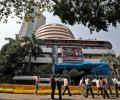
India remains one of the most over-owned market in Asia.

Finance Minister Nirmala Sitharaman's biggest challenge will be to find a new growth driver, particularly against the backdrop of a global economy ravaged by heightened uncertainty and fragmentation, financial markets on a precipice, and global commodity prices on a continued uptrend.

Equity markets fell on Monday, with benchmark indices recording their worst session in over two months amid caution ahead of the US Federal Reserve's (Fed's) policy announcement and renewed uncertainty over the US-India trade deal. Sustained selling by foreign portfolio investors (FPIs) also weighed on sentiment.

The convergence of artificial intelligence, evolving labour regulations and rising employee expectations will redefine how organisations manage pay, people and performance in the coming year, a report says.
